How Do AI SEO Agents Work Under the Hood?
AI SEO agents don't just report data like traditional tools — they decide what to do and execute it. Here's the actual architecture behind them, step by step.
TL;DR
An AI SEO agent is a system that doesn't just show you SEO data — it decides what needs to happen and does it. Most of them follow the same loop: understand the goal, collect data from tools like Google Search Console and analytics, let an LLM decide the next action, execute that action, then check the outcome and repeat. That autonomy is what separates an agent from a traditional SEO tool, and it's also where the risk comes from — one bad decision can compound across hundreds of pages.
Key takeaways
- →Traditional SEO tools show you data; AI SEO agents decide what to do with it and take the action themselves.
- →Most AI SEO agents run the same five-step loop: understand the goal, collect data, decide, act, then check the outcome.
- →The LLM acts as the decision-maker in the middle of the loop — it's only as good as the data the tools feed it.
- →More autonomy means more leverage on hundreds of pages, but also less control — a bad call can scale just as fast as a good one.
- →Distribb, Scrunch AI, Surfer, and AirOps are examples of products already building toward this agentic model.
On this page
SEO used to mean pulling reports, spotting problems, and manually fixing them one at a time. AI SEO agents change that by closing the loop themselves — researching, deciding, and acting without waiting on a human for every step. Here's what's actually happening under the hood.
What are AI SEO agents?
AI SEO agents are AI systems that perform SEO work on their own — things like checking which pages are ranking on Google, studying what's working, and replicating it in future content — instead of just reporting data for a human to act on.
A normal SEO tool gives you data and tells you what to do. An AI SEO agent figures out what needs to be done and executes it in a sequence of actions. That's the core difference: one hands you a to-do list, the other works the list itself.
Traditional SEO Tools vs AI SEO Agents
| Traditional SEO Tool | AI SEO Agent |
|---|---|
| Finds keywords people are searching for | Researches the change needed and decides what should be updated |
| Monitors what pages are ranking in search results | Searches Google and AI search engines to understand what already ranks |
| Scans the website to find broken links | Fixes broken links and pages on its own |
| Checks what websites are linking to your page | Adds internal links and suggests pages that should link to it |
| Shows what keywords competitors are targeting | Studies competing pages and identifies what they missed |
| Tracks traffic and analyzes performance | Iterates on its own if a page is underperforming |
The pattern across every row is the same: a traditional tool stops at information, an agent continues into action. Traditional SEO tools display data and require a human to act on it — an AI SEO agent actively executes tasks and manages decisions itself.
Key insight
"Agent" here doesn't mean a chatbot that answers SEO questions. It means a system with tools, a goal, and the ability to take multi-step action toward that goal without a human approving each individual step.
Who needs an AI SEO agent?
AI SEO agents are most useful for businesses that depend heavily on organic search traffic but have too much SEO work to handle manually. If your SEO workload is small, the overhead of running an agent probably isn't worth it yet.
This is especially true for:
- Enterprise marketing teams managing hundreds or thousands of pages.
- SEO agencies handling SEO work for multiple clients at the same time.
- Large websites where content, pricing, product information, or other data needs to be updated frequently.
- Content-heavy businesses that need to continuously research topics, create content, optimize existing pages, and monitor search performance.
The more SEO work you have to do repeatedly, the more useful an AI SEO agent becomes. If you're comparing specific products for your situation, our best SEO tools for small businesses in 2026 breakdown is a good next stop.
How do most AI SEO agents work?
Most AI SEO agents follow a simple architecture. The common pattern is:
- Give the agent a goal
- Let it break the goal down into sub-tasks
- Let it gather information
- Let the agent decide what to do with that information
- Let it use tools to act
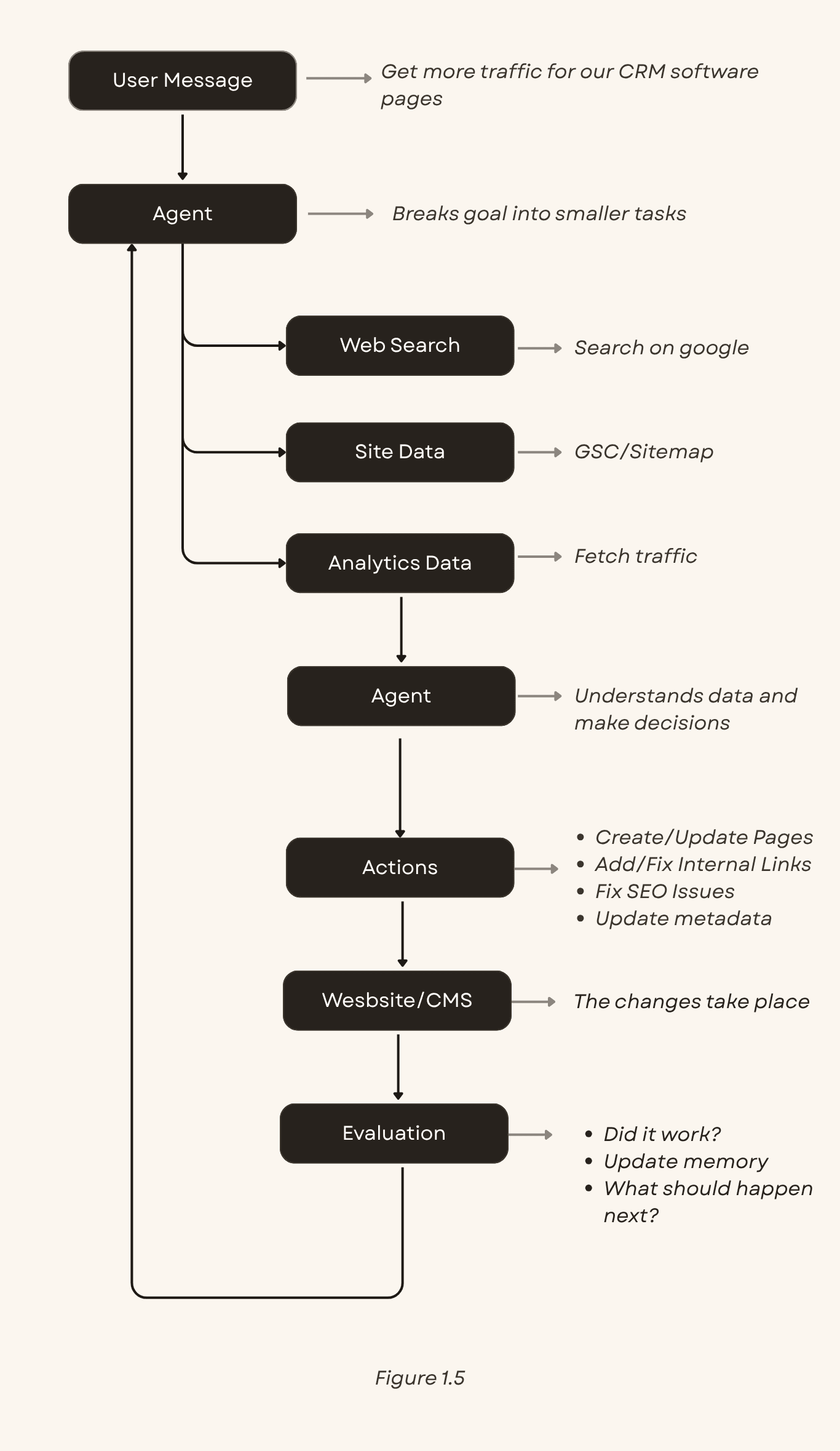
- Check the result
- Repeat
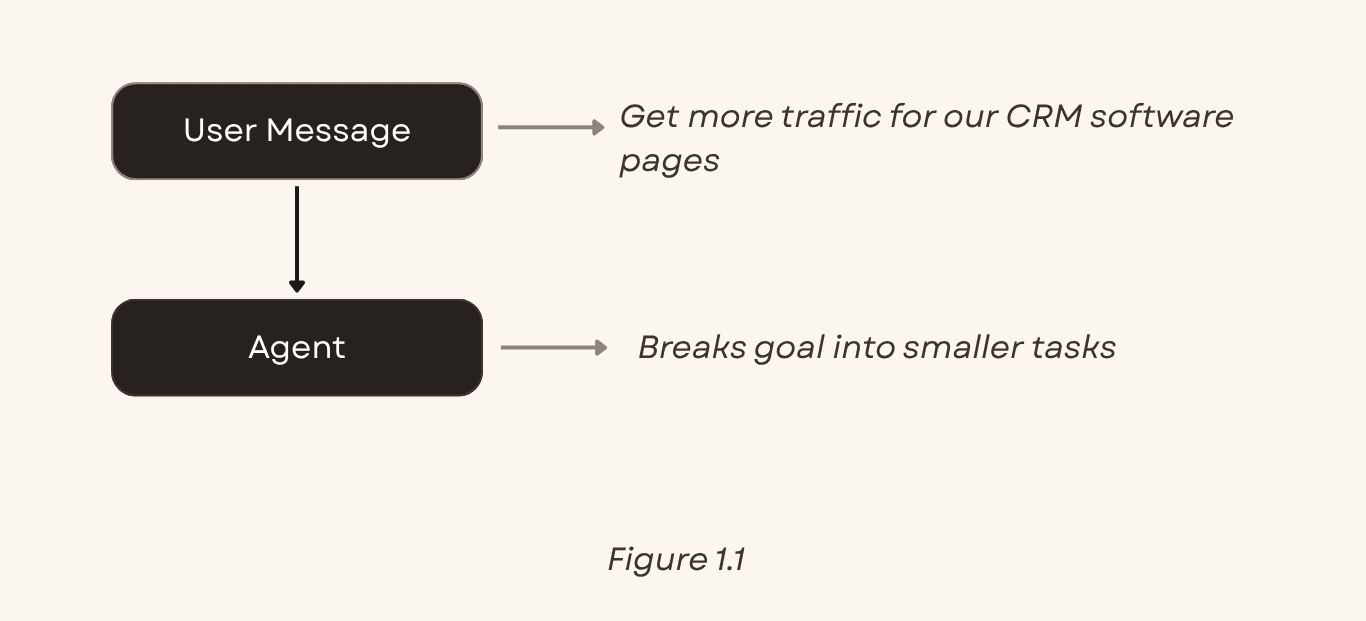
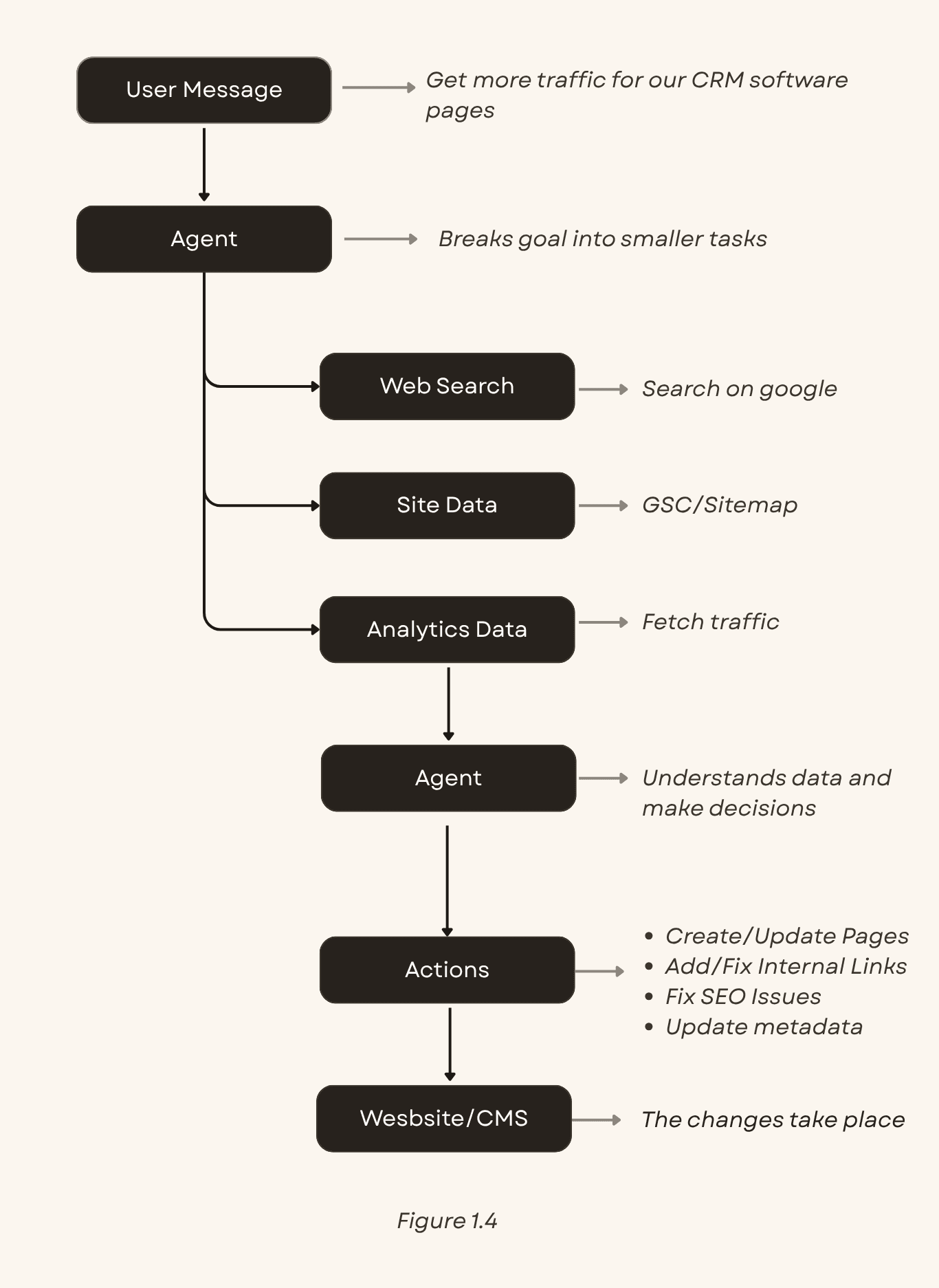
Here's what that looks like step by step. Say you tell your agent: "Get me more traffic for our CRM software pages."
Step 1: Understand the goal
The agent breaks the goal down into smaller jobs. In this example, it will find relevant keywords, study competitors, find content gaps, and create or update pages.
Step 2: Collect information
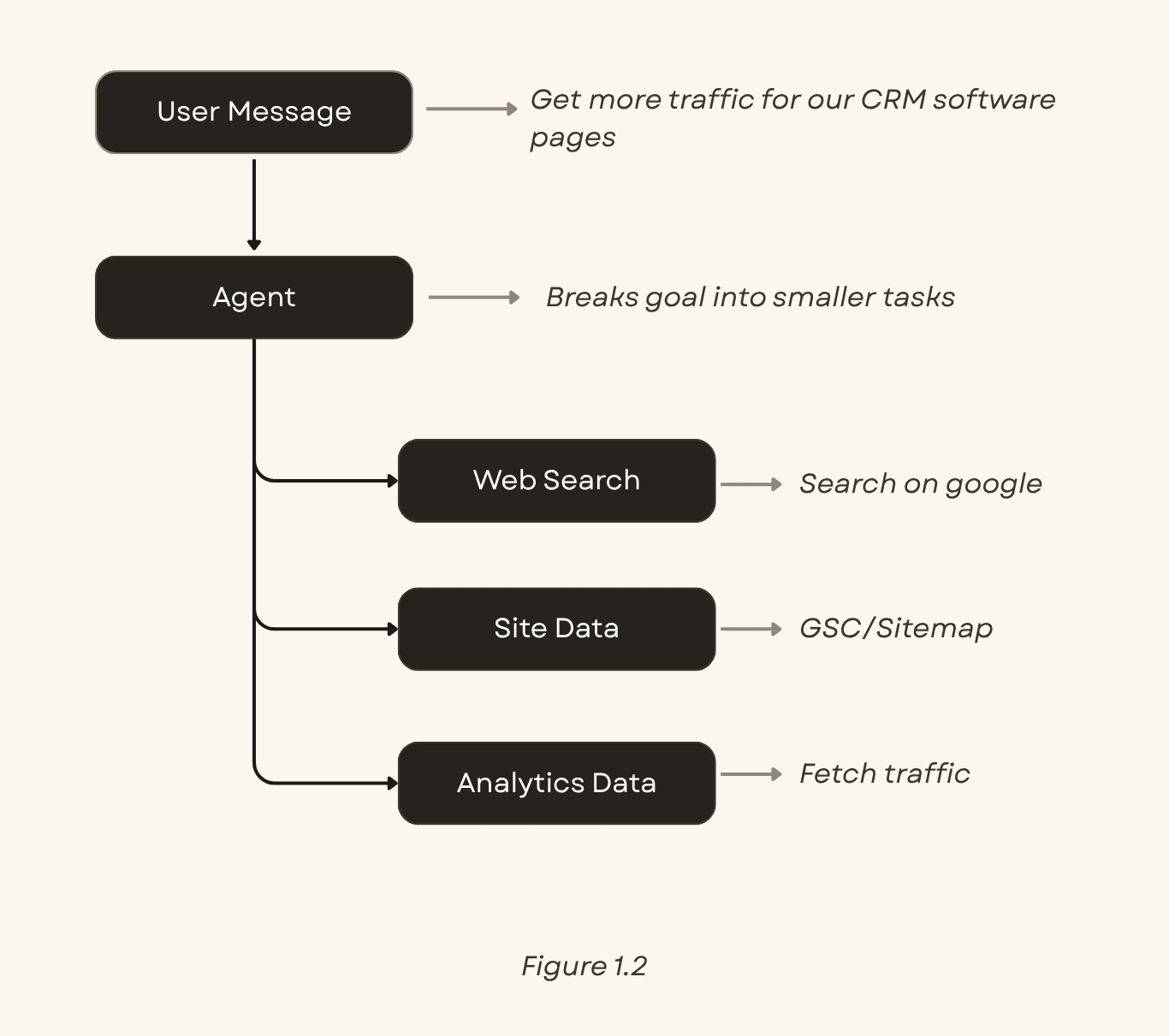
The agent calls different tools to get information instead of relying on a human to enter it or the AI to guess. For example:
- Search engines → what competitors rank for
- Google Search Console → what your site is already getting impressions for
- Website crawler → what pages you currently have
- Analytics → what visitors are actually doing
These tools give the agent concrete, current data to work from rather than a prediction based on training data alone.
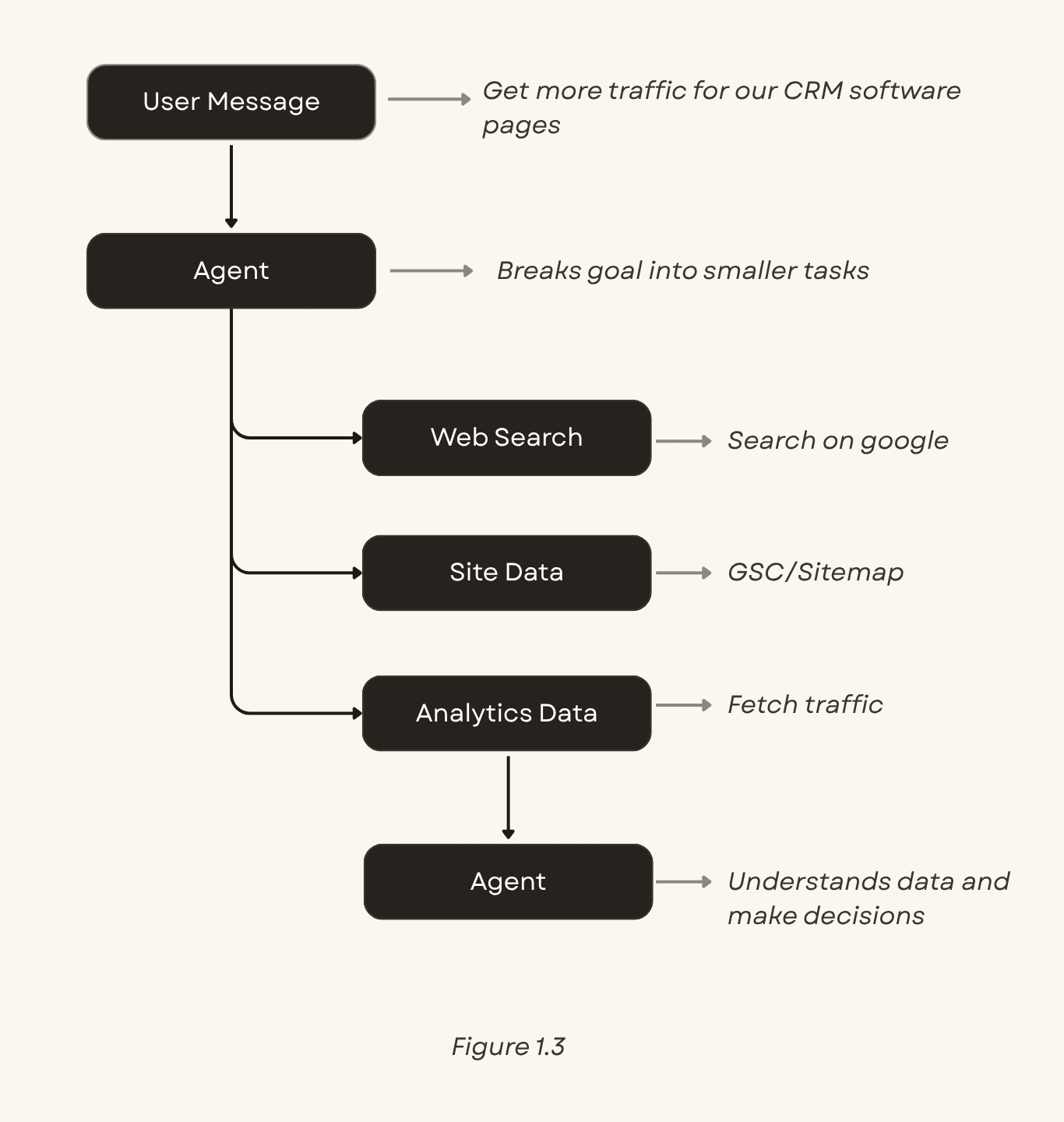
Step 3: The agent (LLM) acts as the decision-maker
The collected information is sent to an LLM, which works through the data and concludes what action to take next. It might reason something like: "We already rank #12 for 'CRM automation software.' Rather than creating another article, improving this existing page is probably the better opportunity."
Step 4: The agent takes action
Now the agent executes the task the LLM concluded on in the previous step. Depending on what permissions and tools it's been given, it might:
- Rewrite sections
- Add missing topics
- Change the title or meta description
- Add internal links
- Create supporting content
- Publish through your CMS
Warning
What the agent is allowed to do here matters more than how smart it is. An agent with read-only access can only suggest changes; one with CMS write access can publish them without anyone reviewing first.
Step 5: Check the outcome
After making changes, the agent can come back and check whether anything actually improved — comparing rankings, impressions, clicks, conversions, and other metrics. If the result isn't good, it starts another cycle of research and adjustment.
What are the benefits and tradeoffs of this architecture?
The same autonomy that makes AI SEO agents useful at scale is also what makes them risky without guardrails. Weigh both sides before deciding how much control to hand over.
| Benefits | Tradeoffs |
|---|---|
| Handles far more SEO work than a person could — 10 to 1,000+ pages | One bad decision can generate many bad pages before anyone notices |
| Actually executes the tasks instead of just listing them | The agent is only as good as the data it's given |
| Can continuously monitor the website without being asked | Information overload can lead the LLM to make incorrect decisions |
| Combines multiple data sources, like GSC and analytics, into one decision | More autonomy means less control over what actually ships |
| Creates a feedback loop — it can iterate when something isn't working | Can get expensive and technically complicated to run well |
What apps can help you with AI SEO?
A handful of products are already building toward this agentic model, each with a different focus. Distribb is one worth a closer look if you want the full loop — research, writing, and backlinks — running with minimal manual input.
- Distribb — an autonomous AI SEO agent that researches, writes, and builds backlinks to drive sales.
- Scrunch AI — monitors and optimizes how your brand shows up in AI search results.
- Surfer — content optimization and AI-visibility tracking built around real-time SERP data.
- AirOps — a content engineering platform for building and running AI-powered content workflows.
What should you actually do with this?
Don't hand an AI SEO agent full autonomy on day one. Start it in a review-only mode — let it research, decide, and draft, but keep a human approving before anything publishes — and only expand its permissions once you've seen a few cycles of decisions you'd have made yourself.
Frequently asked questions
What's the difference between an AI SEO agent and a traditional SEO tool?
A traditional SEO tool collects and displays data — rankings, backlinks, broken links, competitor keywords — and leaves the decisions and execution to a human. An AI SEO agent uses that same kind of data but adds a decision-making layer and the ability to act on its own: rewriting pages, adding internal links, or publishing content directly through your CMS without someone manually doing each step.
Is an AI SEO agent safe to run without supervision?
It depends on how much autonomy you give it. Because the agent can execute changes across many pages in a single cycle, a wrong decision doesn't stay contained to one page — it can be repeated everywhere the agent acts. Most teams start with limited permissions (like drafting instead of auto-publishing) and expand autonomy as they trust the agent's decisions.
Who actually benefits from using an AI SEO agent?
Teams with more SEO work than they can handle manually — enterprise marketing teams managing hundreds of pages, agencies juggling multiple clients, and content-heavy sites that need constant research, optimization, and monitoring. If you're publishing a handful of pages a month, a traditional tool is probably enough.